Here we go! I’m taking you behind the scenes of the creation of an 8 page Batman story I’m writing and drawing for the upcoming Batman: Black & White series. This is scary for me for a bunch of reasons.
First, I’ve never done a mainstream comics story–one that I’ve written and drawn–all by myself. I’ve usually teamed up with friends for these things and it’s a great security blanket to be working with people you trust. This one is all me, from concept to completion, so if it sucks, it’s 100% my fault.
Secondly, it’s Batman. I’ve loved Batman since I was a little kid and while I’ve gotten to draw him a few times in my career, it’s never been in a featured role. It’s something I’ve felt that I needed to do for a long time and now I have the chance to say something about a character who’s meant a lot to me. Something my younger self would be proud of. No pressure.
Thirdly, it’s Batman: Black & White. Basically designed by former DC art director Mark Chiarello to be a showcase for the best artists in the industry. The book will be filled with incredible art from people at the top of their game and I have to sit somewhere in there and not be awful by comparison.
And fourthly, I’m going to share it all with you guys. From lousy first ideas to script-writing to rough drawing to final art (and maybe some lettering??). This thing will take shape as I continue to work on it. It’ll change, be awkward, and hopefully come out polished in the end and you get to see it all happen. Whew. So let’s get started…
THE CONCEPT(S)
I needed an idea, so I did what I always do: put on some tone-appropriate music and wander around with my head in the clouds. My first thought was that I wanted to play on the idea of black and white. Like, why does this story need to be black and white? What about it would work better here than in colour? How do I play to the strengths of the medium? And above and beyond all that, what do I really have to say about Batman that hasn’t been said before, or is at least unique to me. That part is tougher. I pored through the first few volumes of Batman: B&W to see what other creators had done and tried to envision my place among them. I started by just writing out a bunch of ideas that might make good springboards for stories. Here they are, straight from my notes:
Story Ideas
- Batman investigates a crime scene from the 1800s by way of an old black and white photograph.
- Batman is approached by a psychic to stop a murder that she claims is about to be committed.
- Bruce Wayne is seduced by an extremely lifelike android in a corporate takeover attempt.
- Maps Mizoguchi interviews for the Robin position.
- Batman listens in on a couple’s debate, ready to intervene if things get violent.
- A criminal leaving Gotham by plane sees the bat signal out of his airplane window.
- An old woman who claims to have been alive since the 1800s wants Batman to bring her great-great-grandson’s killer to justice.
- A séance from 1870 pulls Batman into a crime scene investigation in the past.
- Batman and Robin enter a creepy old house in Gotham, led by the house’s current occupant, who tells them that his great-great grandmother has appeared in the attic demanding retribution for her untimely death.
- They enter the attic and sure enough there’s an old lady sitting there in a chair who claims to be Lady Davenport. This was her house when the city was booming in 1870.
- Batman determines she’s a real human, not a projection or trick. Her skin is cold to the touch and her eyes are milky white.
- Robin asks if she’s a ghost. Batman tells her there’s no such thing.
- Lady Davenport appears to look through him, saying she can see his past and his pain. She says that she was murdered by her husband’s jealous brother–a man who had courted her before she was married and turned to liquor.
Okay, so there are some weird ones in there. But I landed on something I liked (highlighted in red) and started to work out a simple story progression. Here’s the one-sentence pitch I sent to DC for approval:
While investigating mysterious noises from an old Victorian townhouse, Batman is pulled into a séance in 1870’s Gotham where he must solve the case of an elderly couple’s missing grandchild.
Creepy, haunted house ghost story vibes and a connection to Gotham city’s history. AND… Robin in this story is Maps Mizoguchi. It’s basically a short Hellboy-style story but featuring Batman’s detective prowess instead of Hellboy’s fisticuffs. Now to flesh it out…
ROUGH SYNOPSIS
The editors were curious enough about the short pitch to ask for a more fleshed-out idea of the story. I wrote up a page-by-page synopsis (mostly to figure out how I was going to cram this story into 8 pages) which details the movement of the plot, sets up characters, and offers a (hopefully) satisfying ending. Here’s what I sent them.
SPOILER WARNING! If you don’t want to know what happens, STOP READING NOW.
PAGE ONE
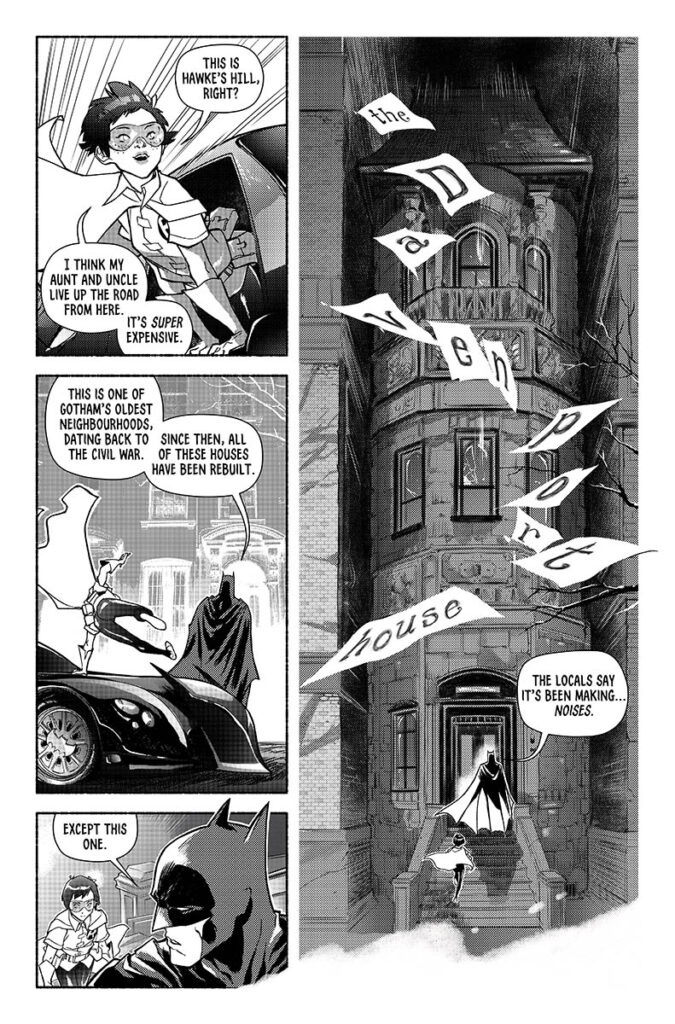
A large image of a creepy old Victorian house in the middle of Gotham’s expensive Hawke’s Hill neighbourhood. It looks classically haunted and derelict, surrounded by much fancier townhouses. Lately, the house has been making…noises. Neighbours have been complaining. Batman and Robin enter. TITLE and CREDITS.
PAGE TWO
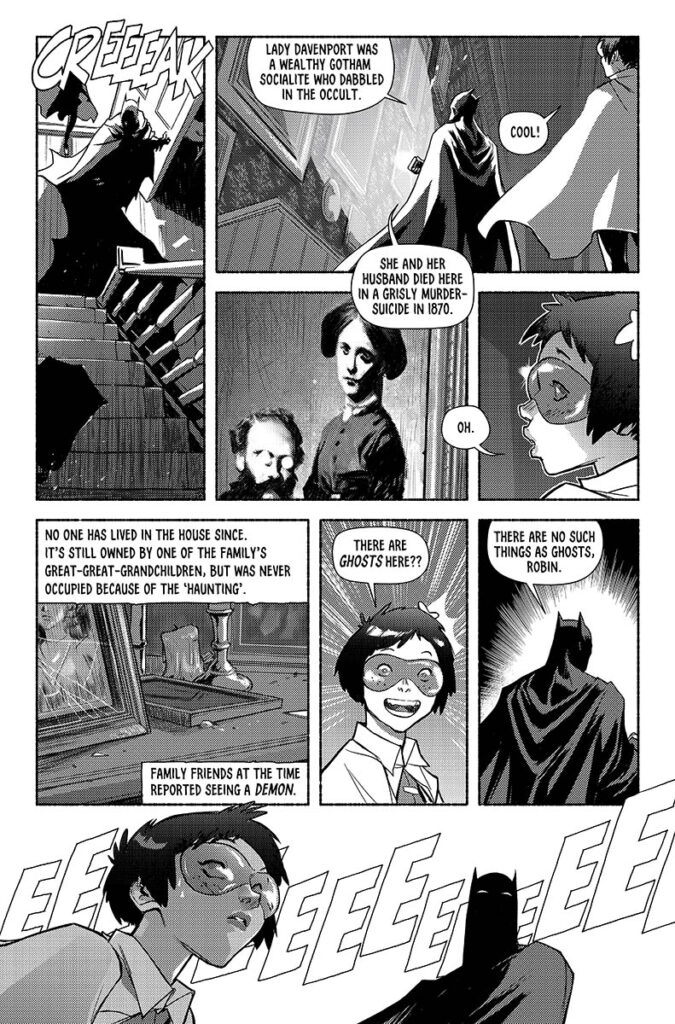
They search the dark, musty house. Robin says her aunt and uncle live not far from here–this neighbourhood is super expensive. Why is this house abandoned? Batman says it’s been empty since the turn of the century. It’s the Davenport House. Lady Davenport was a wealthy Gotham socialite who dabbled in the occult. She and her husband died here in a grisly murder-suicide in 1870 and no one has lived in it since. It’s still owned by one of the great-great grandchildren of the family but never occupied because of the haunting. Family friends at the time reported seeing a demon. ‘There are ghosts??’, Robin asks. ‘There are no such things as ghosts, Robin.’ The house screams out, objecting. The noise is coming from upstairs.
PAGE THREE
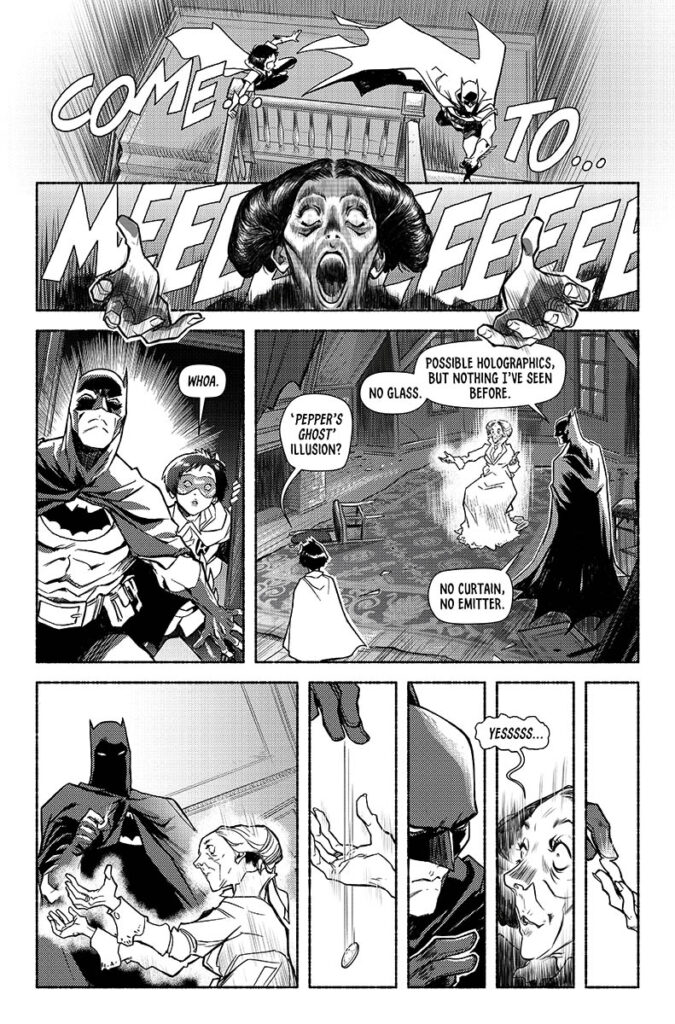
Batman and Robin enter the attic, a large room that was once ornately decorated but is now mostly empty save for a mouldy oriental rug, some cobwebbed lamps and an old woman sitting in a chair in the middle of the room. She looks ghostly, her eyes milky white. She calls out toward Batman, her hands reaching out to him. ‘Come to meeee’. Robin holds up her phone with a wiki image. ‘Lady Davenport?’ Batman looks at her dubiously. He walks around the old woman, examining her and the surrounding room with a detective’s eye for detail. ‘Oh! Pepper’s Ghost illusion?’, asks Robin. ‘No glass.’, says Batman. ‘Possible holographics, but nothing I’ve seen before. No curtain, no emitter.’ Batman drops a coin through the woman’s translucent hand. It falls to the floor. He reaches out to touch her. As he does, she moans ‘Yesssss. Come to me. Come…’ Batman touches her hand with his own. And…
PAGE FOUR
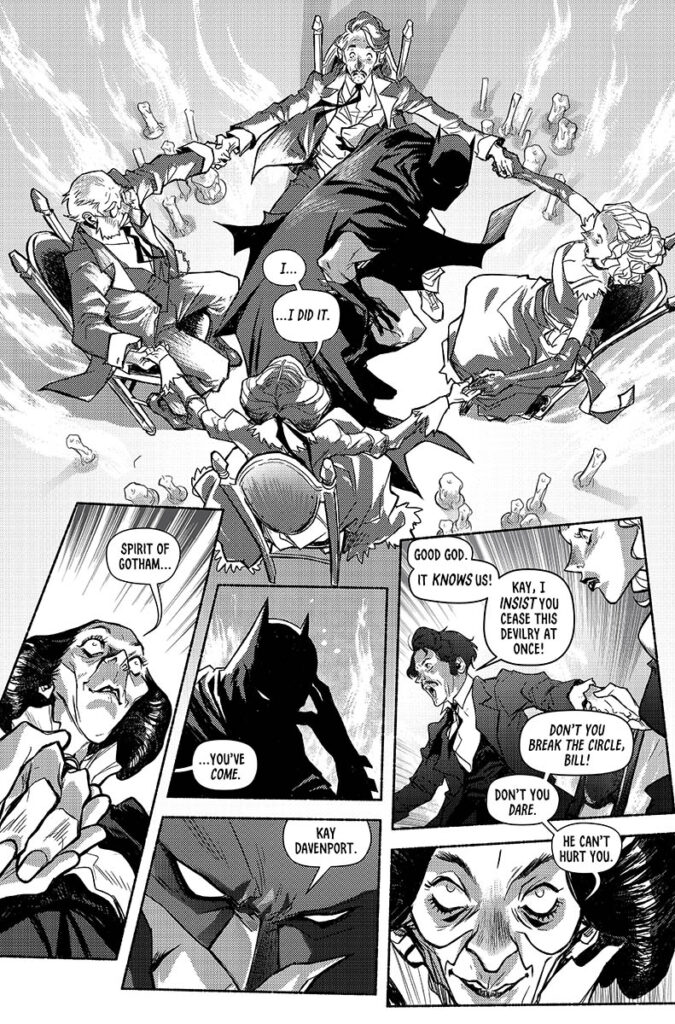
In an instant, Batman finds himself standing within a circle of people. It’s the same room but candle-lit and fully decorated with tables and chairs, wall hangings, paintings, etc. The rug is spotless. Robin is nowhere to be seen. There are four people in a ring around Batman–a séance. One of them is Lady Davenport, very much alive and healthy. Beside her is her husband, Graeme Davenport, and on the opposite side are two friends of theirs, the Whitbys, all holding hands. The group recoils in shock at Batman’s appearance, all except for Lady Davenport, who appears elated, tears of joy in her eyes. ‘I… I did it. You’ve come.’ Batman, disoriented, looks at the woman. ‘Kay Davenport.’, he says. She smiles. The Whitbys freak out. William wets his trousers. ‘Don’t you break the circle, Bill!’, says Lady Davenport. ‘Don’t you dare.’ Batman looks her in the eye, still trying to figure out the trick here. ‘He can’t hurt you. He’s going to find Jeannie for us.’
PAGE FIVE
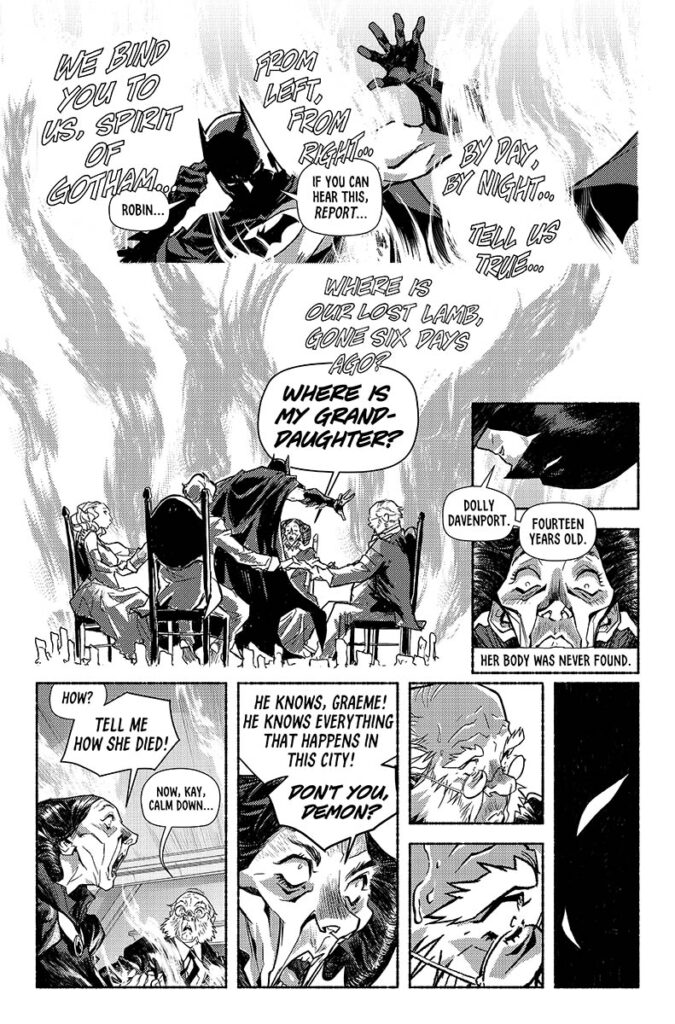
Batman tries to move from the circle but can’t; he’s blocked by some invisible force. Unwilling to believe in superstition he calls out. ‘Robin!’ No answer. ‘Alfred, if you can hear me, shut down power to HH Block 6.’ Still nothing. Lady Davenport goes on: ‘We bind you to us, spirit of Gotham…’ She says that she’s summoned this spirit to find her missing granddaughter, gone six days ago. Have you seen her? Is she of the spirit world now? Batman recollects what he remembers from the records of the house murders. ‘Jeannie Davenport. Fourteen years old. …her body was never found.’ Lady Davenport sinks a bit in her chair. Her husband tries to console her. ‘Now, now, Kay.” Irene Whitby voices her protest to the proceedings, saying that it’s devilry. But Davenport goes on questioning Batman. ‘How did she die? Who did this?’ Her husband tells her to calm down. But Davenport says, ‘He knows, Graeme. He knows everything that happens in this city. Don’t you, demon?’ Graeme starts to look nervous, a bead of sweat on his temple. Batman notices.
PAGE SIX
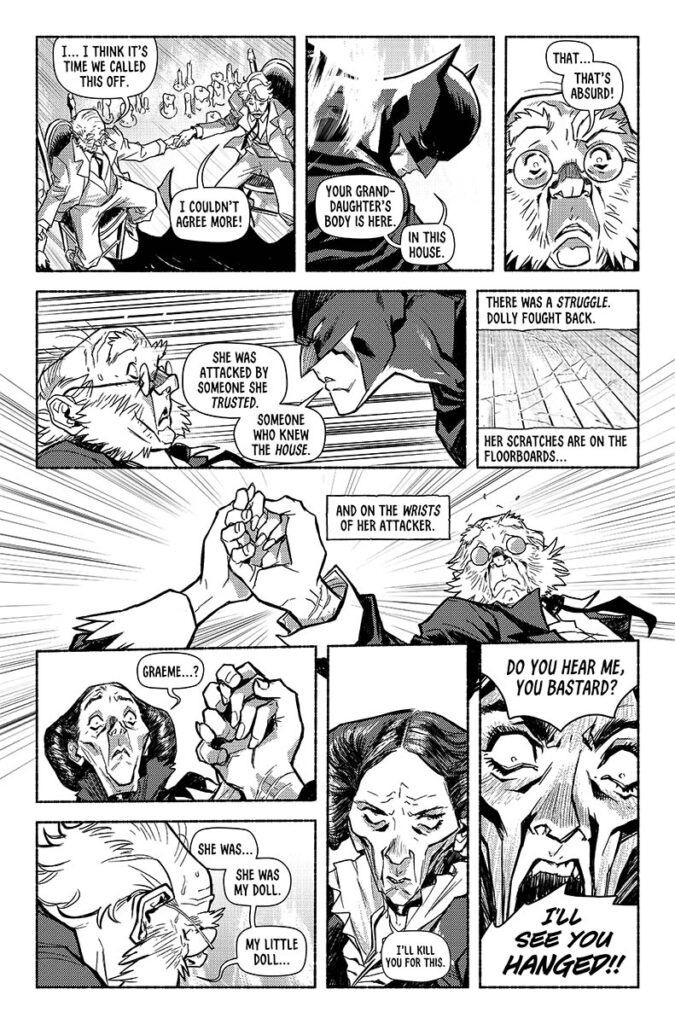
Batman crouches low to meet the man’s shifty eyes. He questions him about his whereabouts and deduces that Jeannie never left the house on the day she went missing and neither did Graeme, despite his alibi.
Graeme tries to yank his hand away but Lady Davenport twists it and keeps hold. ‘…Graeme? You…no, you couldn’t…’ Graeme is in tears, mumbling, ’My little doll… she was my little doll… I’m so sorry…’ Lady Davenport’s expression changes to one of pure hatred as she turns on her husband. ‘I’ll kill you for this. Do you hear me, you bastard? I’ll see you hanged!’
PAGE SEVEN
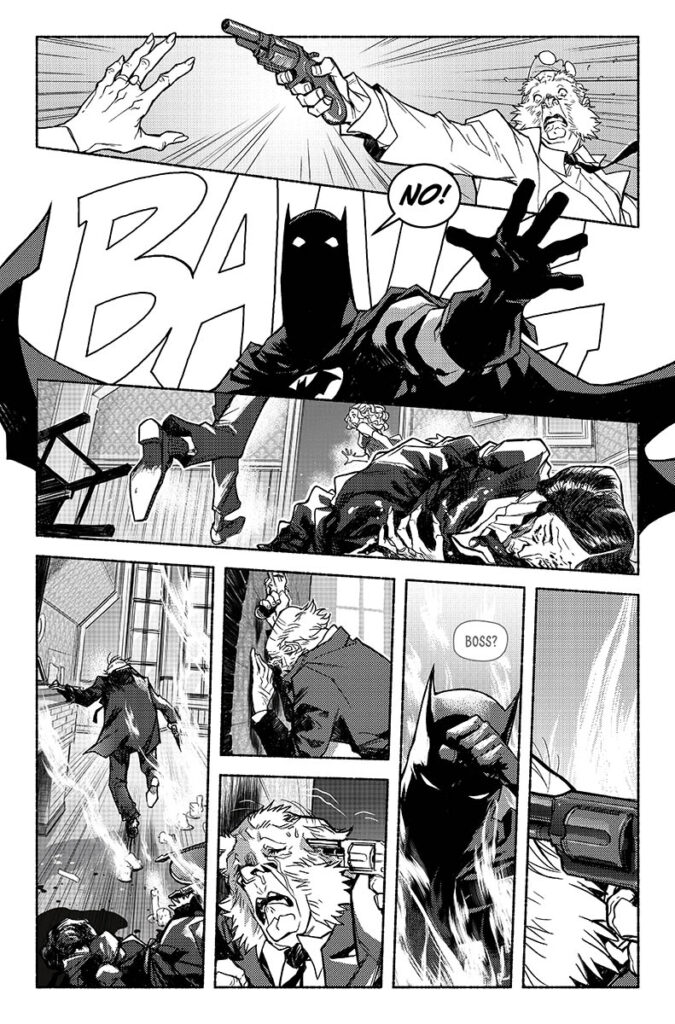
Graeme pulls a small revolver from his coat and shoots Lady Davenport. Batman shouts ‘NO!’ But there’s nothing he can do. She falls to the floor, blood flowing from her neck. The Whitbys run screaming from the room.
The circle broken, Batman begins to fade away as Graeme staggers to the far corner of the room and slumps against the wall, crying. He claws awkwardly at the wall, then puts the gun to his own head and pulls the trigger. With a gunshot, Batman is back in the present, somewhat shocked by the time displacement. Robin is standing there as though he never left. ‘You okay, boss?’
PAGE EIGHT
REMOVED FOR SECRECY!!! Read the story to find out how it ends.
END
As you can see, there’s a gaping hole on page six where Batman actually deduces who the killer is and why he did it! That’s because I haven’t figured it out yet. But hopefully I’ll come up with something satisfying and appropriately detective-y. I have maybe two-thirds of a page for Batman to actually do some detective work, so it has to be pretty tidy and to the point. I also don’t have a title yet. Hopefully something will present itself in the scripting stage. Anyway, that’s a problem for FUTURE KARL.
This synopsis was approved, so I’m on to the next stage…
THE SCRIPT!
Yes, the script. I told myself I would write a full script for this story both to show my editor and for myself (the idea being that I’d flesh out some parts of the story and reduce the thinking time in the drawing stage) but when I started writing it I found that I was just copying the sample dialogue I’d already written in the synopsis, which was a waste of time. So no script. It was already done. Instead…
THUMBNAILS
I usually don’t thumbnail anything. For those who may not know what ‘thumbnailing’ is, it’s when you draw a small (thumbnail-sized, sort of) version of each page as a rough draft of your story to get down initial page composition ideas and see an overview of the story as a whole. Usually, they’re around a quarter-page each and very rough, though some people will do very detailed thumbs and blow them up larger to ink directly over them.
Anyway, I usually don’t do them at all. Not because I don’t think they’re valuable, but because I have a hard time ‘seeing’ the page at that reduced size. I work better at actual size and the few times I’ve done thumbnails the end product has looked nothing like my roughs so I just quit bothering altogether. But it’s one thing to do that when you have a finished script from another writer and an entirely other matter when you’re writing it yourself and it’s not yet fully formed. So I decided that doing thumbnails for this story would replace the scripting process and help me to figure things out (which it did!)
I started by taking a precious, new notebook and carefully ruling in templates in which to experiment with page composition, adding nice titling and notes to the margins. I did two or three pages of thumbnails this way and then threw it away when I realized I’d just be copying them all to the iPad for the final drawing anyway. Doing my roughs digitally gave me so much more freedom to move things around and sketch, and I could also add the rough lettering at the actual printing size to get a better idea of how the page flow would work. I have to say, as someone who usually doesn’t letter his own pages, it’s helpful to do it just to get an accurate notion of how much space you have to work with. Lettering myself also gave me new ideas about how to compose a page–sometimes using the lettering as the feature element of a panel instead of a drawing. Yay, Comics!!!
Here are the thumbnailed roughs I sent to my editor for approval. In the process of doing these, I (think I) solved the problem of how Batman identifies the killer. I feel like in cramming these pages with actual story progression I lost a lot of the nuance that was in my initial outline but it is what it is. I have eight pages to work with. In the end, some dialogue editing will have to fill in any gaps in the story. See what you think (page eight has been omitted to prevent spoilers!)…
Click for slideshow…
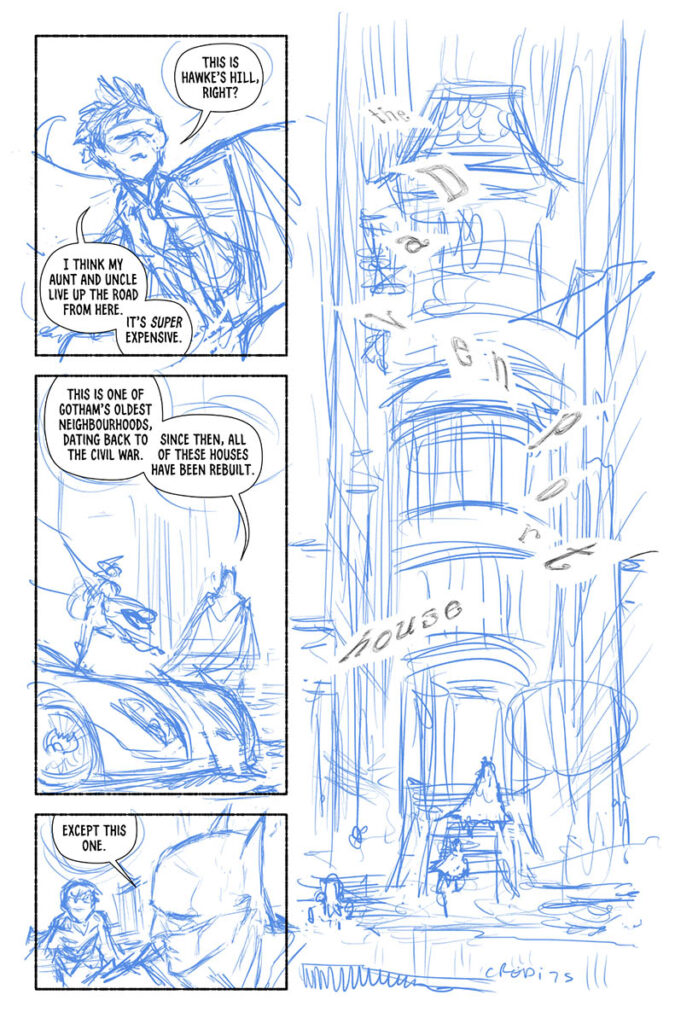
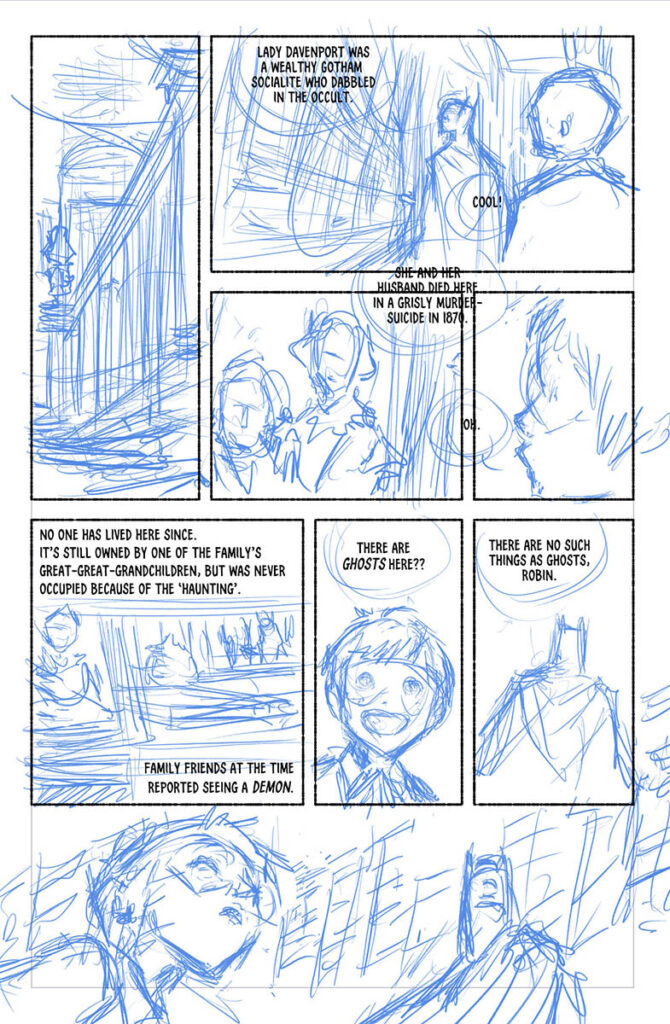
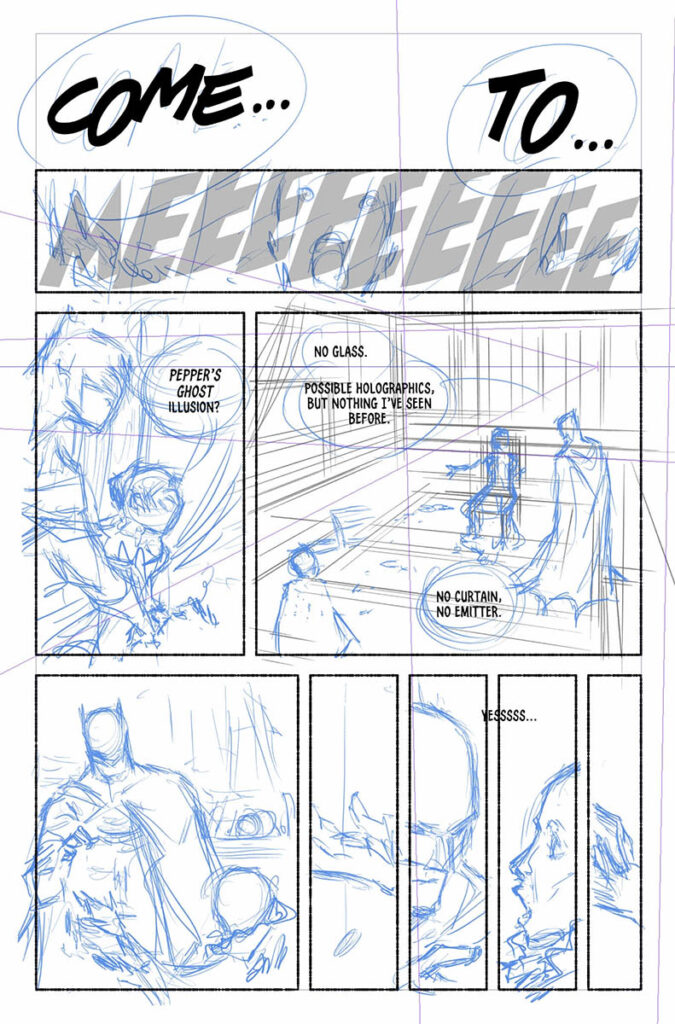
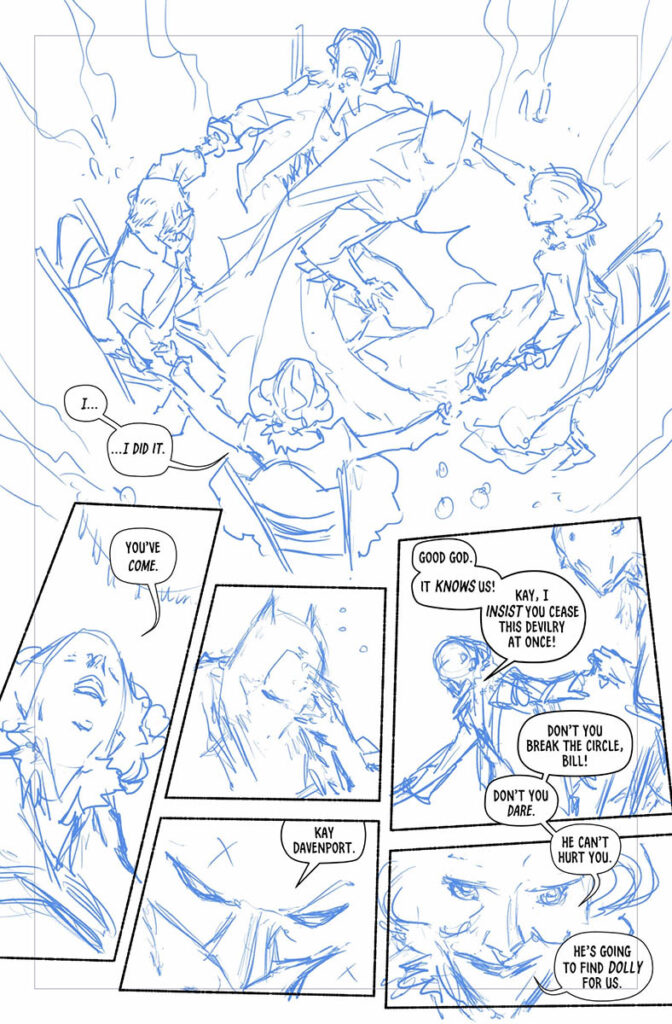
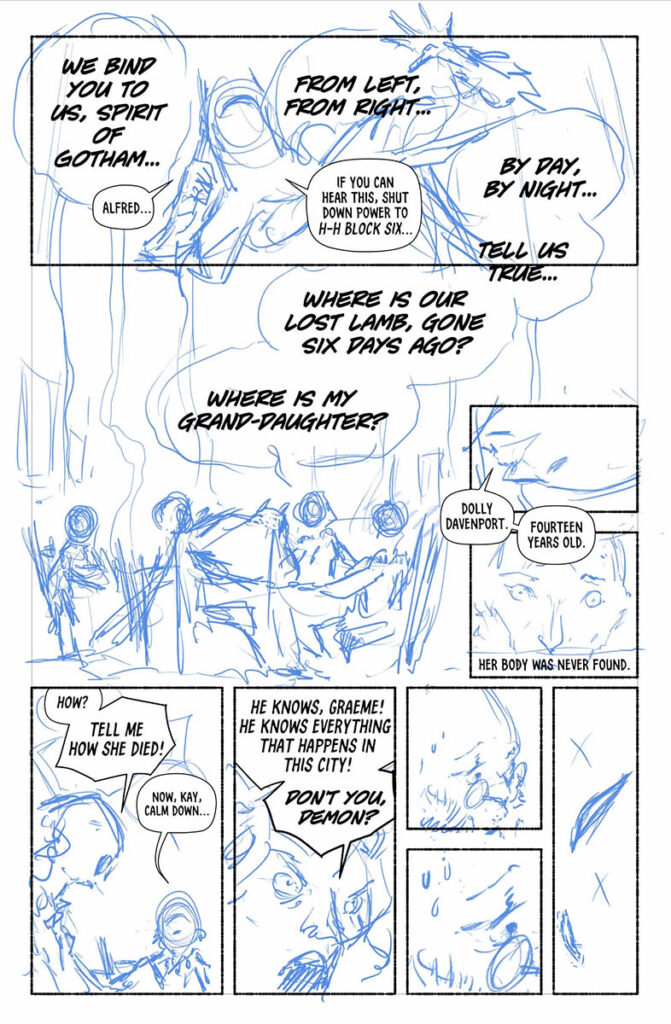
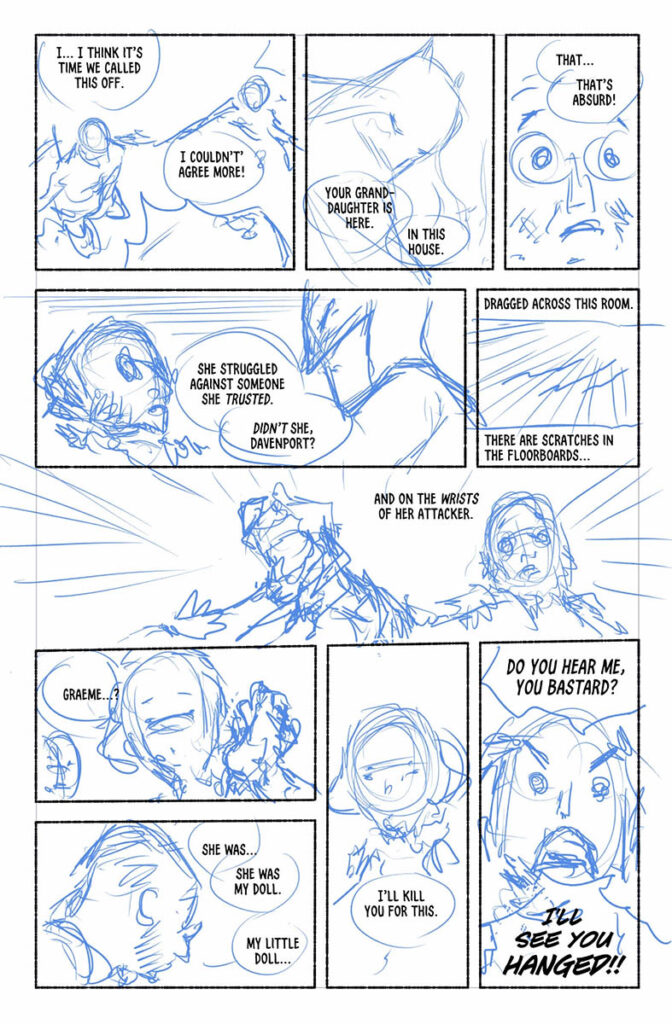
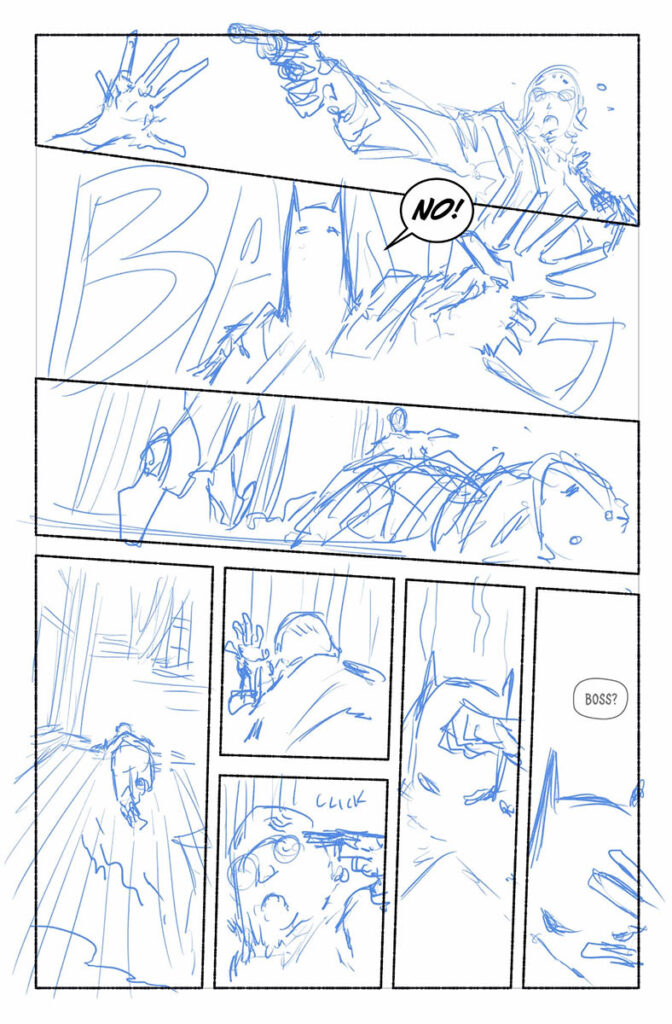
Hopefully this is readable for you guys. A lot of it is very rough, but it was enough for the story to be approved and so we’re moving on to…
INKING!
Can’t publish these ugly rough blue pencil sketches like this, so it’s time for the finishing touches! I say that, but a lot of the actual drawing happens in this inking stage.
When contemplating a black & white story like this, especially a Batman one, the instinct is to use really heavy black areas and shadows to keep it all looking gothic and moody. Part of me really wanted to try that, but I assumed that most of the other contributors to the book would be going that route so I decided that I’d look to black and white manga for inspiration. That’s what I’d been looking at anyway for the last year or two–lots of Shonen Jump comics and speed lines and halftone shading. I thought maybe I could pull off something like that without embarrassing myself too badly.
Luckily, ClipStudio Paint (the application I’m using to do all of my drawing on the iPad) has a very simple way to do halftones (or screen tones as they’re sometimes called). It’s literally a one-button conversion from a shaded grayscale layer into a dot pattern and you can easily adjust the frequency of the dot pattern (or Undo it!) at any time.
I used one tool, a 6B pencil brush, and various shades of grey to get the effect I wanted. In traditional manga fashion, some of the background elements are just photographs that have been level-adjusted to look more like ink drawings (I think I actually only did this once on the first page). I used patterns for bricks and wallpaper and rug textures. Everything else is just ink rendering.
Regarding the tones: I told myself that I wanted to keep it very simple and I made a rule early on to only ever use two levels of tone throughout. No fancy gradients, etc. I broke this rule immediately. You can see that the first few pages look overly dense, almost as though it’s been ‘painted’ with tones. I was like kid with a Photoshop lens flare. By the end of page 3 I think I got the hang of it and limited myself to using them as accents and leaving more white space. Much better.
Overall, I’m really happy with the way it turned out. But there’s still the GREAT UNKNOWN…
What will it look like in print???
I have no idea! Will these dots print too small? Be off-register? Get muddy? Will the lines suffer? I guess we’ll find out together!
That’s it for inking! It took a long time–longer than I’d normally take for an 8-page story–but I think it was mostly because of nerves and the desire to get it right.